


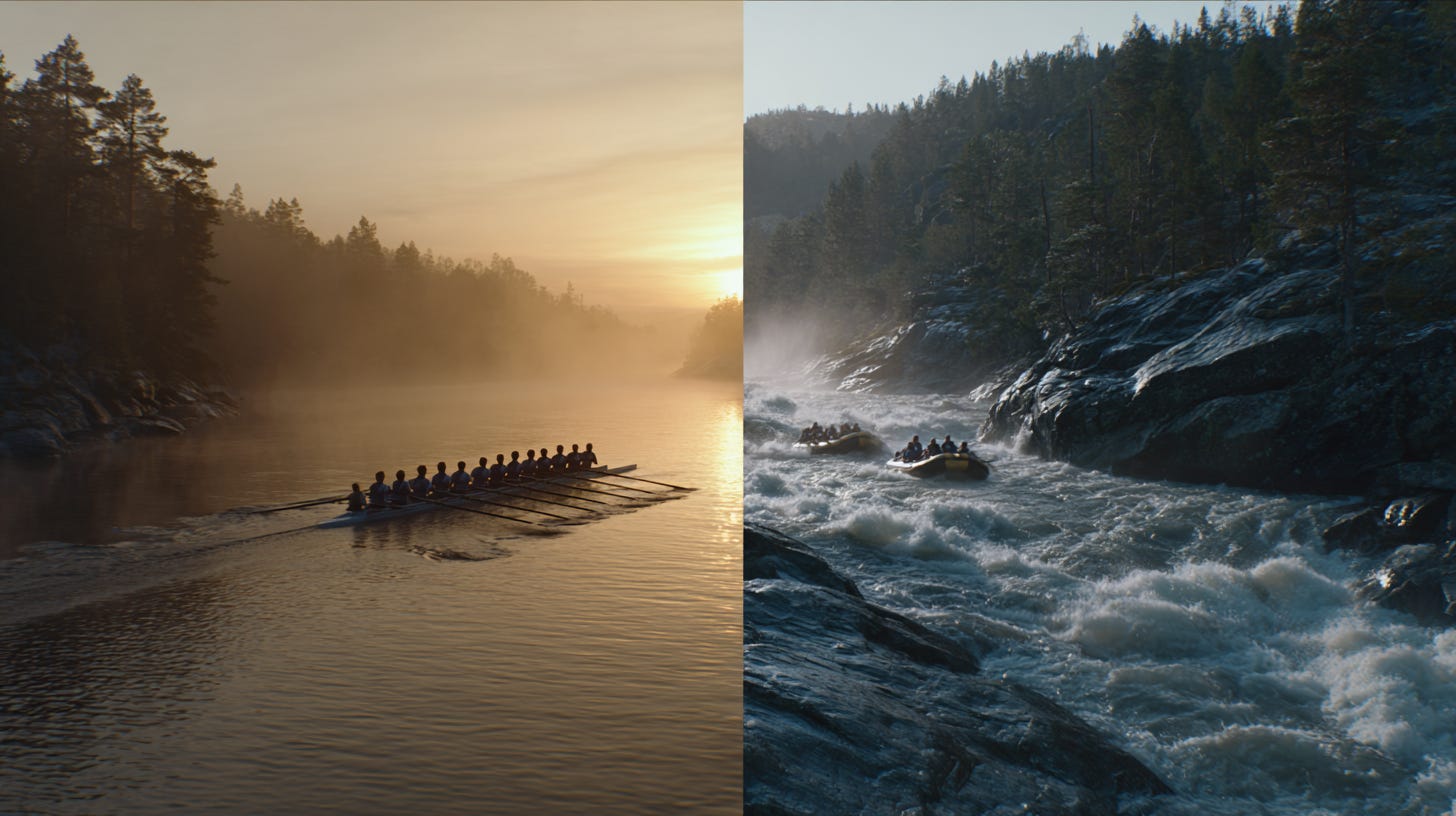
Picture a college rowing team. You know, the ones we often see in movies.
A long, narrow boat where everyone faces the same direction, oars hitting the water in perfect rhythm, and at the back of the boat, one person calling the beat. Stroke. Stroke. Stroke.
It’s all about synchronization; same tempo, same movement, no improvisation, no hesitation. Everyone does exactly the same thing at exactly the same time.
This is the image of perfect collaboration we carry in our heads: everyone pulling in the same direction, following the same leader, agreeing on tempo, method, and goal.
It’s a very comforting image.
And it’s also completely misleading.
The Problem With Perfect Sync
Because that’s rarely what real-world collaboration looks like, and it certainly doesn’t look like that when it comes to the many complex challenges we’re battling today - like the energy transition.
The energy transition is not linear, not tidy, not predictable. It’s also not led by one voice, and it’s definitely not possible to “get in sync” all the time.
If someone actually stood up and shouted commands, chances are half the people have AirPods in while the other half are googling something they just found really interesting.
Some are rowing, some are paddling, some are holding back because they see something ahead, while others are paddling too hard because they think we’re running out of time. Some are checking the map, some are debating the map, and some are wondering who made the map in the first place.
And some are asking a more fundamental question: Why are we in this boat anyway?
Yet we often insist on talking about collaboration as if this should be solvable with a bit better rhythm, a bit clearer leadership, a bit more discipline, as if the problem is that people don’t want to collaborate.
But that’s not it.
The problem isn’t lack of will. The problem is that we’re using the wrong metaphor for what collaboration actually is.
Book I'd Forgotten About
A week ago, I was on my way to a course, a learning program called Energiomstillerne (The Energy Transitioners). I was sitting on the train to the airport and pulled out my Kindle to read a book I’d just bought.
As so often happens, the train Wi-Fi only half-worked and the book wouldn’t download.
So I started scrolling aimlessly through my library, looking for something already there. Then it appeared: a book I’d downloaded maybe a year ago because someone recommended it, and then it had drowned in a pool of other recommendations.
Collaborating with the Enemy by Adam Kahane.
I think the universe was speaking to me via the non-existing train Wi-Fi. The timing could not have been better.
My personal project that I’d brought with me to work on during the program was something that’s been on my mind for years: how do we build bridges between the oil and gas bubble and everyone standing outside it? Between people with vastly different interests, tempos, understandings of reality, and answers to what the right way forward is.
Do you see why I found the title of the book interesting?
I started reading.
This is not beach reading exactly. But somewhere between Gardermoen and a tunnel outside Oslo, things began to click.
Kahane distinguishes between what he calls conventional collaboration and stretch collaboration.
Conventional collaboration assumes alignment: shared goals, shared understanding of the problem, agreement on the plan. It assumes we can map the route, divide the tasks, and move forward in sync.
Stretch collaboration is different.
It accepts that we don’t fully agree, that we don’t see the system in the same way, that we don’t trust each other completely, that we cannot control the process.
And that’s where the rafting image comes in.
Collaboration in complex systems isn’t like following a roadmap, it’s more like navigating a river you don’t fully control, together but not identical.
I haven’t finished the book yet. But if the first chapters are anything to go by, I suspect there are many more epiphanies waiting somewhere between here and the last page.
Rafting, Not Rowing
In Norway we have a river called Sjoa where parts of it run quite wild with real rapids, cold water, stones beneath the surface, currents and turns you don’t quite control. This is a popular spot for white water rafting, and a typical image will show multiple rafts with a bunch of people in each going down the river.
Everyone is not in the same boat. But they’re all in the same river.
Some take on the rapids aggressively, paddle hard, take chances, want to get down fast. Some brake because they see something ahead, some are genuinely afraid, some choose the calmest line they can find tight to the riverbank, while others love the adrenaline and think this is the most alive they’ve ever felt.
Everyone is moving downstream, whether they want to or not.
But at completely different paces, in completely different ways, with different experience, different risk tolerance, and different reasons for being there.
To me this image makes so much more sense than the rowing team on a calm river.
Because the energy transition is not one boat with one rhythm, it’s many rafts in the same rapids. Some are paddling for their lives, some are holding back, some are shouting warnings, and some are shouting “this is fine”.
And yet: we’re in the same river.
Different Rafts, Same Room
It was with this image in mind that I entered the days with Energiomstillerne.
For three days we wrestled with what it actually takes to accelerate the energy transition, not just in theory, but in ways that work across sectors, across interests, across different views.
The people in the room approached that question from very different angles. Some operate inside established industries while others challenge them from the outside. Some think in policy, some think in technology, some think in capital, some think in culture.
Some of us were in the same raft. Others were clearly in different ones. And even when sitting side by side, we paddled differently.
The goal is not full agreement, not harmony, not that everyone thinks the same, wants the same, or moves in the same way.
The goal is enough understanding to stand in the same river without pushing each other out.
Yes, we’re moving downstream. But we’re getting there in very different ways.
Why We Paddle Differently
The differences aren’t just about interests or power. They’re about experience, personality, geography, risk tolerance, time horizon, what we’re responsible for, what we’re afraid of, what we stand to lose.
When we forget that, we start interpreting different speeds as resistance, different strategies as lack of will, different concerns as sabotage.
But through the rafting image, it becomes less dramatic. We’re just rafting, in different rafts, through the same rapids.
I’ve moved from sitting right inside the oil and gas bubble to standing on the outside looking in, and I can still put on that old hat, remember what felt rational, what felt threatening, what actually makes sense from there.
That space between inside and outside is where I’m most curious now. Not to get people in sync, but to build enough understanding to keep us in the same river.
More on this soon. For now, I'm just trying to stay in the river.